Cloud & Infrastructure Playbook
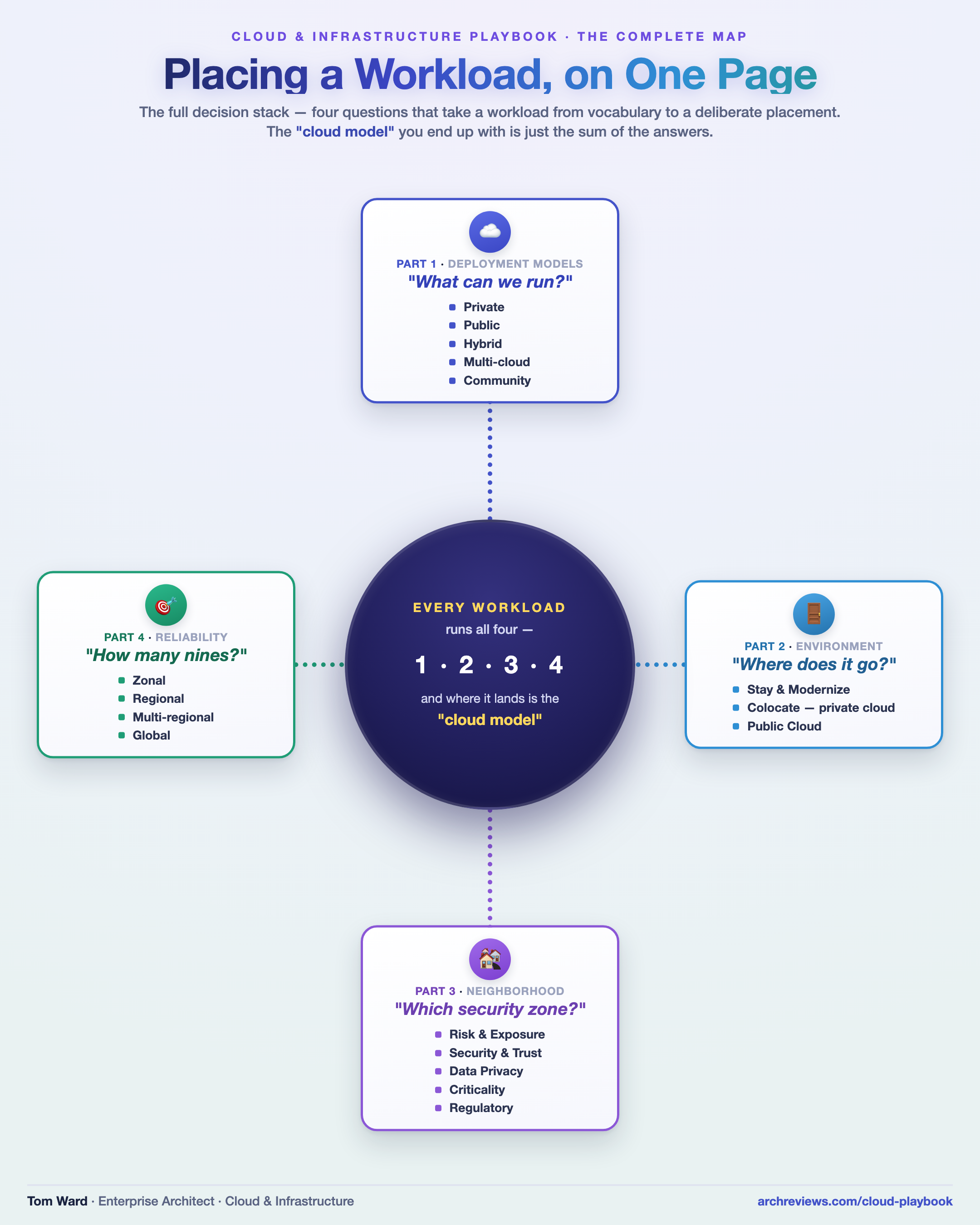
Four field guides that turn “what cloud model should we use?” into the decision it actually is: placing each workload, on purpose. The arc runs top-down — the deployment models are vocabulary; then, per workload, you choose an environment, a security neighborhood within it, and a reliability archetype. The “cloud model” you end up with is just the sum of those answers. Each part ships as an architecture infographic, a deep-dive PDF you can hand to your team, and a checklist — written from twenty-plus years of Fortune 500 infrastructure and platform work, in the same vendor-neutral spirit as the rest of this site.
By Tom Ward, Enterprise Architect — Cloud & Infrastructure
- Part 1 of 4 PDF
The Five Cloud Deployment Models
Every cloud strategy conversation starts with the same argument: public, private, hybrid, or multi-cloud? It's the wrong argument. If you run a large enterprise, you're already all of them. A practitioner's primer on the five deployment models, their real trade-offs, and why the models are just vocabulary while the actual work is deciding what runs where.
Read part 1 - Part 2 of 4 PDF
Where Each Workload Belongs
A data-center exit almost always starts with the wrong sentence: “we're moving to the cloud.” That collapses three different decisions into one — and it's how migrations miss their budgets and their reliability targets. Colocation is your own private cloud in a rented building; public cloud is a different operating model. A per-workload framework for the three doors out of a data center, and the six signals that decide which one each workload takes.
Read part 2 - Part 3 of 4 PDF
Architecture Neighborhoods
Drop a few hundred applications into a data center — or an availability zone, or a cloud region — and the real question isn't “which rack?” It's “which neighborhood?” You don't seat an internet-facing, low-trust application next to your crown-jewel data. A working guide to zoning every environment into risk-based neighborhoods — and why getting them right is what lets a migration keep its security posture instead of quietly weakening it.
Read part 3 - Part 4 of 4 PDF
Cloud Deployment Archetypes
Three nines is 43 minutes of downtime a month; five nines is 5 minutes a year. You don't close that gap by trying harder — you choose a deployment archetype that can deliver it, and pay what it costs. A working guide to the six cloud archetypes as a ladder, from Zonal to Global (with Hybrid and Multi-cloud as compositions, not rungs), drawn from Berenberg and Calder's Open-Access ACM Computing Surveys paper.
Read part 4
Get each part as it ships
One email per release — the infographic, the PDF, and nothing else.
Subscribe