Architecture Neighborhoods
Drop a few hundred applications into a data center — or an availability zone, or a cloud region — and the real question isn't “which rack?” It's “which neighborhood?” You don't seat an internet-facing, low-trust application next to your crown-jewel data. A working guide to zoning every environment into risk-based neighborhoods — and why getting them right is what lets a migration keep its security posture instead of quietly weakening it.
By Tom Ward, Enterprise Architect — Cloud & Infrastructure
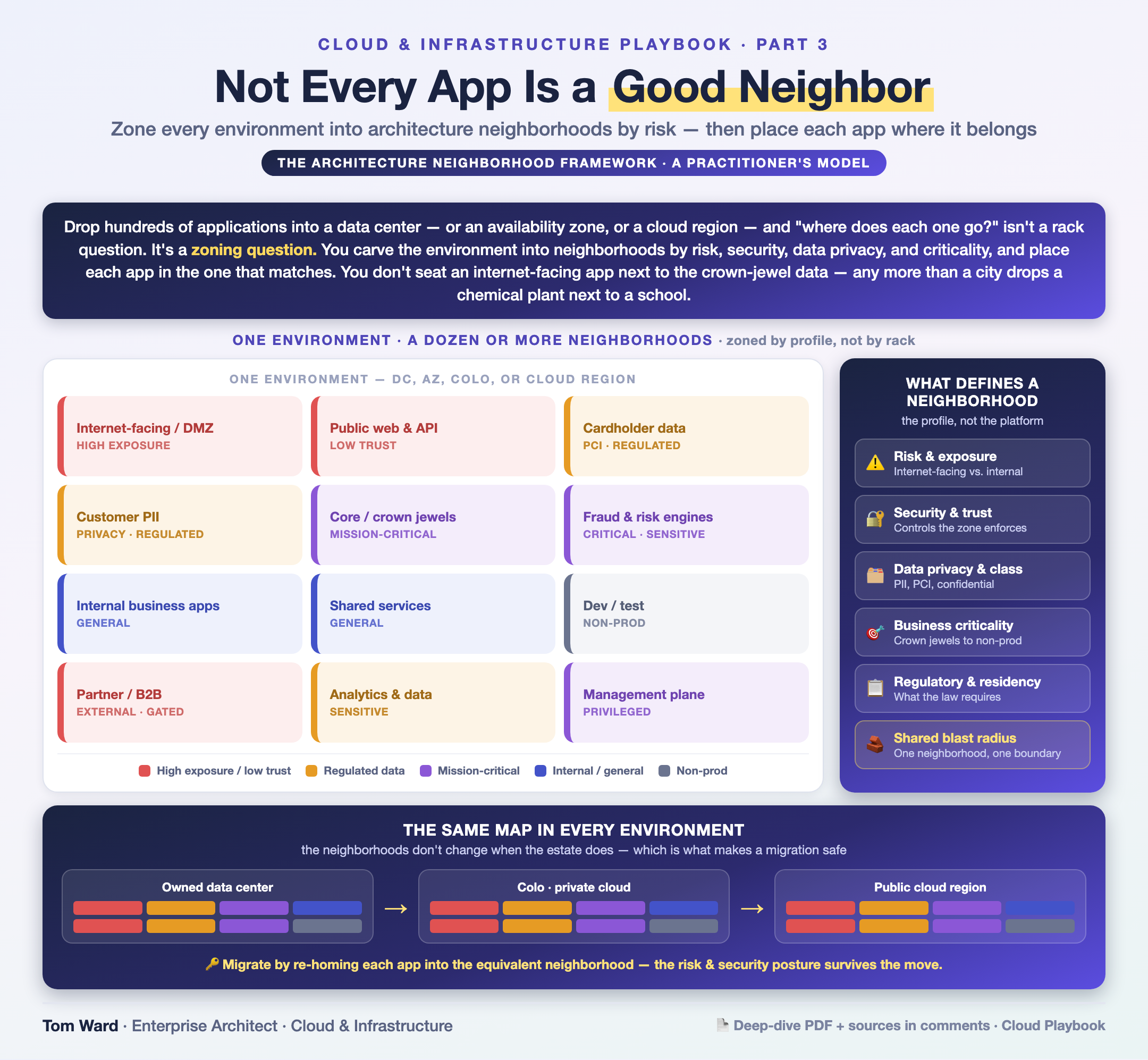
The neighborhoods, by risk band
A neighborhood is a zone within an environment — not a destination. Each data center, availability zone, colo, or cloud region is carved into a dozen or more of them, and every application is placed in the one that matches its profile. A dozen-plus neighborhoods usually cluster into five risk bands; the exact list varies by enterprise, the bands rarely do.
High exposure / low trust
“outermost”Internet-facing and DMZ, public web and API, partner / B2B gateways. Reachable from outside, so tightly inspected and segmented — and kept far from anything sensitive.
Regulated data
“compliance-bound”Cardholder data (PCI), customer PII, sensitive analytics. The controls are set by an obligation, not a preference; the neighborhood exists to make the obligation provable.
Mission-critical
“crown jewels”Core banking and systems of record, fraud and risk engines, the management/control plane. Smallest blast radius, strongest isolation — a compromise here is an existential event.
Internal / general
“the bulk”Internal business applications and shared services. The largest population by count and the easiest to place — but still zoned, so it can't become a soft path to the bands above.
Non-production
“isolated”Dev, test, and staging. Separated hard from production, because non-prod is where controls are loosest and lateral movement is easiest.
What defines a neighborhood
Five characteristics define a neighborhood. Most applications are pulled toward a zone by the strongest one or two.
- Characteristic 1
Risk & exposure
internet-facing or notAn application reachable from the public internet lives in a different trust world than one that isn't — and the two should never share a boundary.
- Characteristic 2
Security & trust
a set of controls, not a locationSegmentation, inspection, identity, least privilege. The zone enforces them so the app doesn't have to reinvent them.
- Characteristic 3
Data privacy & classification
regulated data pulls hardestCardholder data (PCI), customer PII, confidential, public. Regulated data pulls an application into a controlled neighborhood regardless of anything else about it.
- Characteristic 4
Business criticality
crown jewels or dev/testCriticality sets how much isolation the neighborhood needs and how small its blast radius has to be.
- Characteristic 5
Regulatory & residency
often decides firstData residency, sovereignty, audit boundaries. Often this closes the question before the other four are even weighed.
The Zoning Test
Ten checks before you zone an environment — or migrate one. Score one point per honest “yes.” Below seven, you're placing applications by convenience, and your blast radius is larger than you think.
- Every application has a named neighborhood — not just a rack, a subnet, or a resource group.
- Neighborhoods are defined by profile — risk, security, data class, criticality, regulatory — not by team or convenience.
- Internet-facing, low-trust workloads never share a neighborhood with crown-jewel data.
- Each neighborhood is a real boundary — shared segmentation, controls, and failure domain — not just a label.
- Regulated data (PCI, PII) sits in a neighborhood whose controls actually meet the obligation, and can prove it.
- The blast radius of each neighborhood is known and bounded — one compromise doesn't cross the boundary.
- The same neighborhood map exists in every environment you run — owned DC, colo, and cloud.
- A migration plan re-homes each app to its equivalent neighborhood, not “wherever it lands.”
- Your most sensitive workload has a defined equivalent neighborhood in the target environment — if not, that gap is your migration risk.
- Zoning standards run through architecture governance with conformance, so neighborhoods don't erode over time.
Going deeper
Sources worth your time, roughly in the order a team should read them.
- NIST SP 800-207 — Zero Trust ArchitectureThe reference for trust zones, segmentation, and least privilege — the security spine of a neighborhood.
- CISA — Zero Trust Maturity ModelSegmentation as a maturity pillar — a practical yardstick for how well your neighborhoods actually contain risk.
- Microsoft — Azure Landing ZonesHow a neighborhood is expressed in public cloud: subscriptions, management groups, and policy guardrails.
- AWS — Security Reference ArchitectureThe AWS counterpart: accounts, organizational units, and guardrails as segmentation — the same zoning, expressed in AWS.
- The TOGAF® StandardCarrying zoning standards through architecture governance, with conformance, so neighborhoods hold over time.
- Companion — You Don't Choose Five Nines (Part 4)Once an app is zoned, its reliability tier picks the deployment archetype. Zoning and posture, in sequence.
Part of a four-part arc — read the rest of the playbook.
Back to the playbook