Start With Purpose
Most Enterprise Architecture practices don't fail at architecture — they fail at purpose, and get rebooted. The Open Group's own leaders' guide calls the reboot the most common EA practice in industry. A working guide to the four purposes of an EA Capability, the four death traps that trigger a reboot, and the one question the survivors answer before they draw a single diagram: what is this architecture actually for?
By Tom Ward, Enterprise Architect — Cloud & Infrastructure
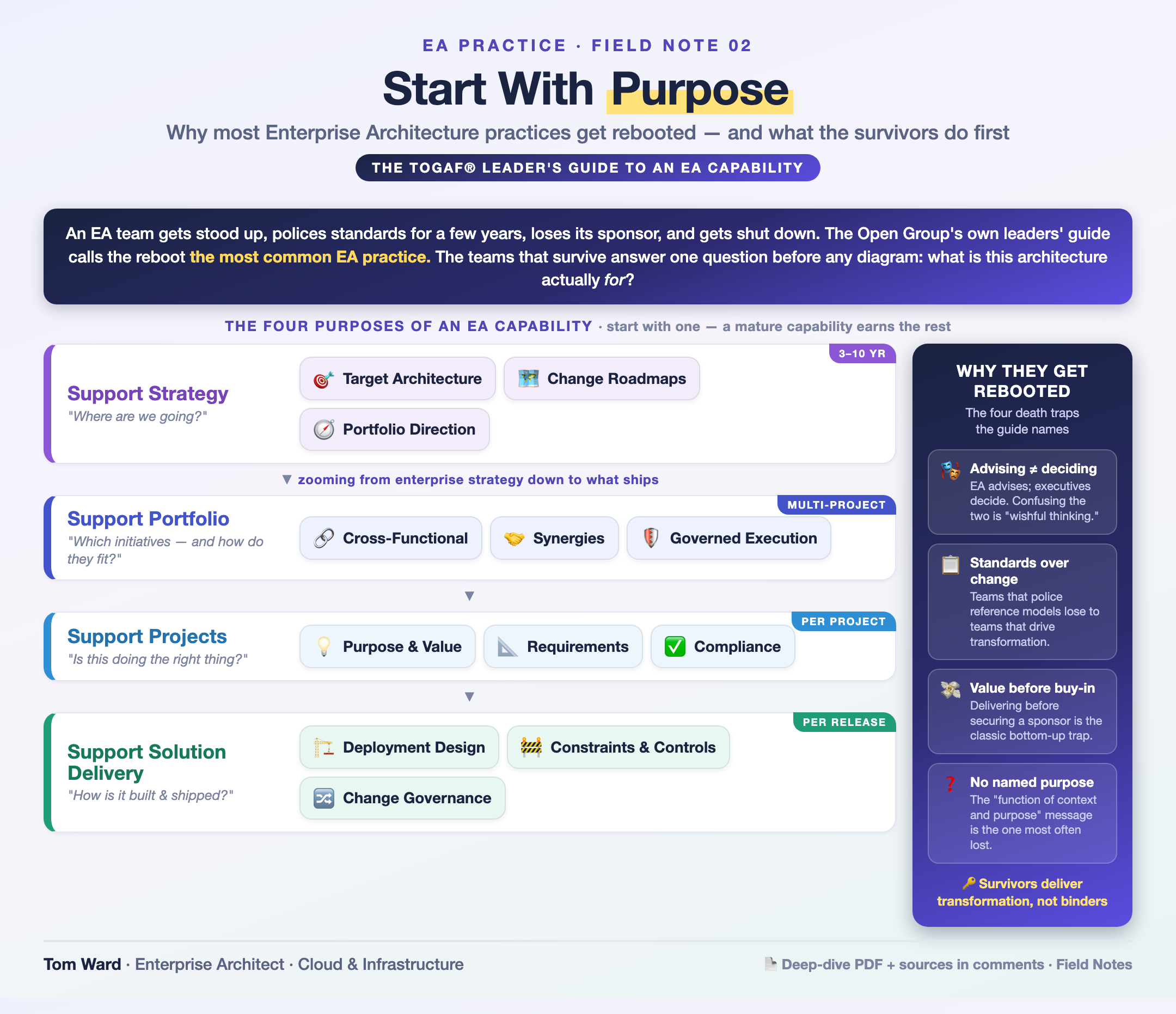
The four purposes — start with one
The guide says an EA Capability serves “one or more” purposes; a mature practice often spans several. But it earns them in sequence, starting from one clear, sponsored purpose. None is more “real EA” than the others — the failure isn't serving one purpose or four, it's never naming any, or claiming all four before you can sustain one.
Support Strategy
“Where are we going?”Target architecture and roadmaps of change over a 3–10 year horizon, spanning many programs and portfolios. The purpose that earns EA a seat at the strategy table — and the one most often claimed without the sponsorship to sustain it.
Support Portfolio
“Which initiatives — and how do they fit?”Cross-functional, multi-project change across a single portfolio: identifying projects, aligning approaches, surfacing synergies and dependencies, and governing execution across the set. Where EA stops being abstract and starts settling real arguments about which initiatives proceed.
Support Projects
“Is this doing the right thing?”Architecture in service of a single project: clarifying its purpose and value, setting requirements, assuring compliance, and integrating with other projects. The most tangible purpose — and the easiest to reduce to a compliance checkpoint that teams learn to route around.
Support Solution Delivery
“How is it built & shipped?”The narrowest and most concrete: how change is designed, built, and delivered, with the constraints and controls the design must honor. Value is realized on deployment and use, so this purpose lives closest to where value actually lands.
The four death traps
Naming a purpose is necessary but not sufficient. The guide catalogues how an EA Capability talks itself into a reboot — four recur often enough to name outright, and each has a cheaper fix than rebuilding the practice from scratch.
- Trap 1
Advising mistaken for deciding
the most common trapEA advises; executives decide. Confusing “supporting a decision” with making it is, in the guide's words, “simply wishful thinking.” The fix: measure the value of good advice — recommendations accepted, risks surfaced early — and keep decision rights and outcome accountability where they belong.
- Trap 2
Standards over transformation
an output, not a reason to existThe guide's most quotable finding: teams that deliver organizational transformation are statistically more successful than teams that focus on standards, reference architectures, and governance structures. A team known only for saying no is one a new CIO can cut without noticing a gap.
- Trap 3
Value before buy-in
the revivalist trapDelivering value before securing a sponsor “has wrought many challenges” — the leader acts on assumption, and when the sponsor doesn't value the result, the team has burned scarce resource failing again. Secure financial allocation and resource commitment first.
- Trap 4
No named purpose
the root causeThe message that an EA Capability is a function of context and purpose “is often lost.” Without a named purpose the team has no test for what to work on, drifts toward documents nobody asked for, and can't answer the question that decides its funding: what would the enterprise do if this capability didn't exist?
The Purpose Test
Ten questions to answer before you establish — or reboot — an EA practice. They come straight from the guide's own guidance on context, purpose, and success measurement. Score one point per honest “yes.” Below seven, you are building on the same ground the last attempt failed on.
- You can name which purpose(s) this capability serves, and the sponsor agrees — and if you're establishing or rebooting, you're starting with one.
- There is a named executive sponsor who will defend the budget through a leadership change — not just the one who chartered it.
- You can answer “what would the enterprise do if this capability didn't exist?” with something concrete, not a platitude.
- The team knows it advises; decision rights and outcome accountability sit with the executives it serves.
- Success is measured by decisions influenced and transformations delivered, not documents produced.
- A charter states the extent of overlap with other functions, the shared responsibilities, and what EA will explicitly not do.
- Buy-in was secured before value delivery — financial allocation and resource commitment are real, not assumed.
- The roadmap is run like a real project: milestones, deliverables, and someone accountable for keeping it true to plan.
- The capability is scoped to a purpose, not the org chart — the next reorganization shouldn't break it.
- Someone tracks which point-of-view documents get read, and by whom — the earliest leading indicator of real influence.
Going deeper
Sources worth your time, roughly in the order a team should read them.
- The TOGAF® Leader's Guide to an EA Capability (G168)The Open Group guide this note is drawn from — establishing and evolving an EA Capability. Start here.
- The TOGAF® StandardThe architecture method itself — the framework the Leader's Guide interprets for practitioners.
- TOGAF Standard, 10th Edition — IntroductionA current, navigable overview of the ADM and the architecture domains referenced throughout.
- The Open Group Architecture ForumWhere the TOGAF standard and its companion guides are maintained and evolved.
- Association of Enterprise Architects (AEA)The professional body for EA practitioners — behind much of the research on EA success and failure.
- MIT CISR — Ross & Weill on EAHome of the research behind Enterprise Architecture as Strategy — tying EA to an operating model and business execution.
- A Digital Product-Centric Reference Operating Model (D-PROM)The Open Group's 2022 model for the shift from project/silo IT to product-centric operating — where a named purpose matters most.
More field notes ship as they're written.
Get the next note by email