What Is a Digital Product?
Ask ten leaders what a “digital product” is and you'll get ten answers — Gartner says executives agonize over the definition. But you can't fund, own, or retire what you can't define. A rigorous definition and a five-part anatomy — Service Offer, Contract, Instance, System, and the other products it depends on — plus the four operating moves the precision unlocks once you can finally say what a product actually is.
By Tom Ward, Enterprise Architect — Cloud & Infrastructure
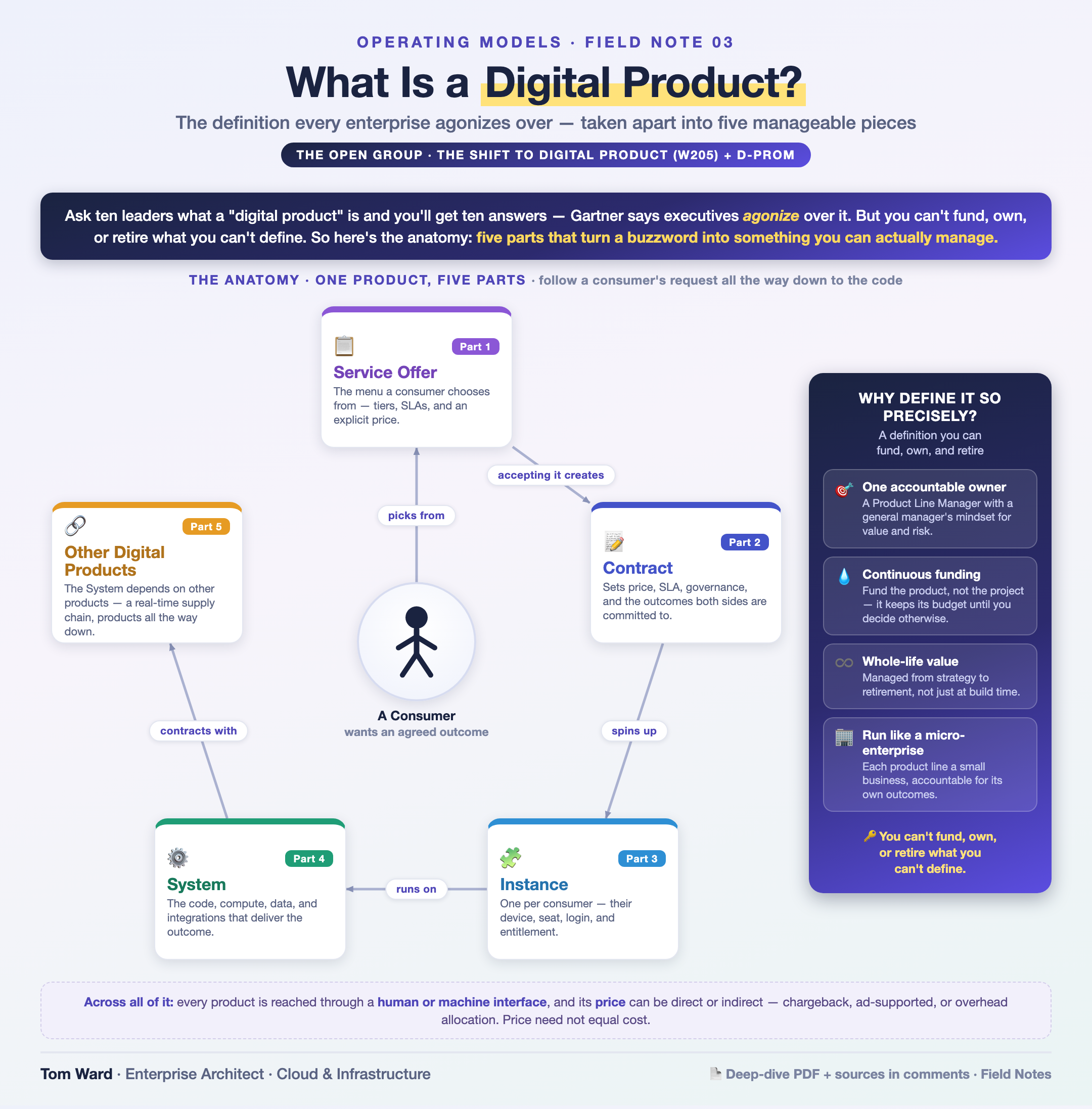
The five parts
The Open Group's rigorous definition: a digital product is anything that delivers an agreed outcome for a consumer, requires software to realize it, is actively managed across its whole lifecycle, and comes with a formal offer of value at an explicit price. Take it apart, and every product — from a mobile app to an internal HR platform — has the same five parts. Follow a consumer's request from the offer down to the code.
Service Offer
“The menu”The menu a consumer chooses from — tiers, SLAs, feature sets, and an explicit price, filtered and presented per consumer type. It's derived from the product definition and documented by the product manager, and a single product can give rise to thousands of possible offers. A full statement of value, not a price sheet.
Contract
“The agreement”What accepting an offer creates: price, SLA, governance, warranties, chargeback rules, usage monitors, and audit rights. Critically, the contract exists separately from the product's technical components and can outlive every user — residual retention and compliance obligations remain after the product is gone.
Instance
“One per consumer”A single realization of the product, created when a consumer accepts an offer — their own device, seat, login, entitlement, and access controls, traceable back to the governing contract. The instance is not the shared platform; it's what one consumer actually holds.
System
“What runs it”The code, compute, data, integrations, and third-party components the provider manages to deliver the outcome — each with its own support lifecycle, managed until no active consumer depends on it. Unlike a physical product, the supply chain is real-time: daily updates demand automated toolchains.
Other Digital Products
“Products all the way down”A system routinely holds contracts to consume other digital products — internal microservices and external APIs like single sign-on, credit checks, or currency lookup — each a technical and financial dependency. These are part of the product's own definition and a factor in its price. The discipline: bind every critical dependency by a formal contract with real governance.
What the precision unlocks
The anatomy isn't academic. A product you can define this cleanly is a product you can actually run — and that is the whole argument of The Open Group's product-centric operating model (D-PROM). Precision at the definition unlocks four operating moves a project-and-silo model can't make.
- Move 1
One accountable owner
value and risk, whole lifecycleA single Digital Product Line Manager owns the product's value and risk across its whole lifecycle — a role that fuses an IT-management competency with a product-and-marketing one, carrying a general manager's mindset rather than a project manager's. Accountability must come with matching authority; “accountability without authority” is the failure mode.
- Move 2
Continuous funding
fund the product, not the projectThe product keeps its budget until leadership deliberately re-prioritizes or retires it — visualized through sliding windows rather than annual approvals. The question shifts from “did this project get approved?” to “which value-delivering products should we invest in?”
- Move 3
Whole-life value
strategy to retirementValue is managed from strategy through retirement, not just at build. Two lifecycles run in parallel — the system lifecycle and the contract lifecycle — mapping to the IT4IT value streams (Strategy to Portfolio, Requirement to Deploy, Request to Fulfill, Detect to Correct).
- Move 4
Run like a micro-enterprise
a small business with its own outcomesEach product line operates as a small, semi-autonomous business accountable for its own outcomes — with decentralized decision-making matched by the authority to act. Consumers may be internal or external, human or machine; the definition holds across all four.
The Digital Product Definition Test
Pick your most important digital product and answer honestly. Score one point per “yes.” Below seven, “product” is still a word in your organization, not a managed thing — and that is a management gap, not a documentation one.
- You can name the product's five parts — Offer, Contract, Instance, System, and the other products it depends on.
- A single accountable owner holds its value and risk across the whole lifecycle — a named person, not a committee.
- The Service Offer is a full value statement — tiers, SLAs, terms — not a price sheet, and it's defined per consumer type.
- Every consumer relationship — including internal and machine-to-machine — is governed by a contract, explicit or implied.
- You can trace any instance back to its contract for chargeback, audit, and support.
- The system's dependencies each have a known owner and support lifecycle, and none is quietly obsolete.
- Every external digital product it depends on is under a formal contract with defined governance — API governance where external.
- Its price is a deliberate decision — direct or indirect — and dependency costs are rolled into its TCO.
- Design, source, and configuration are retained for long-term support — not lost when a project team disbands.
- Residual contract obligations — retention, compliance — are owned even after the product retires.
Going deeper
Sources worth your time, roughly in the order a team should read them.
- The Shift to Digital Product: A Full Lifecycle Perspective (W205)The Open Group white paper this note's definition and five-part anatomy are drawn from. Start here.
- A Digital Product-Centric Reference Operating Model (D-PROM, W223)The operating model built on the definition — funding, accountability, and org design.
- The IT4IT™ Standard 3.0The reference architecture underneath the lifecycle — the value streams the product model maps to.
- Project to Product — Mik KerstenThe book that named the movement, and a pivotal influence on the Open Group's thinking here.
- MIT CISR — Designed for Digital (Ross, Beath, Mocker)The research on digital operating models and product-oriented organizations, cited in W205.
- The Open Group LibraryWhere these papers and their companion standards (DPBoK, IT4IT) are published.
More field notes ship as they're written.
Get the next note by email