Operationalizing LLMs as Enterprise Tools
A six-layer operating model for taking large language models from promising pilot to governed, production-grade enterprise capability — demand, models, grounding, guardrails, delivery, and LLMOps, with governance as the spine.
By Tom Ward, Enterprise Architect — Cloud & AI
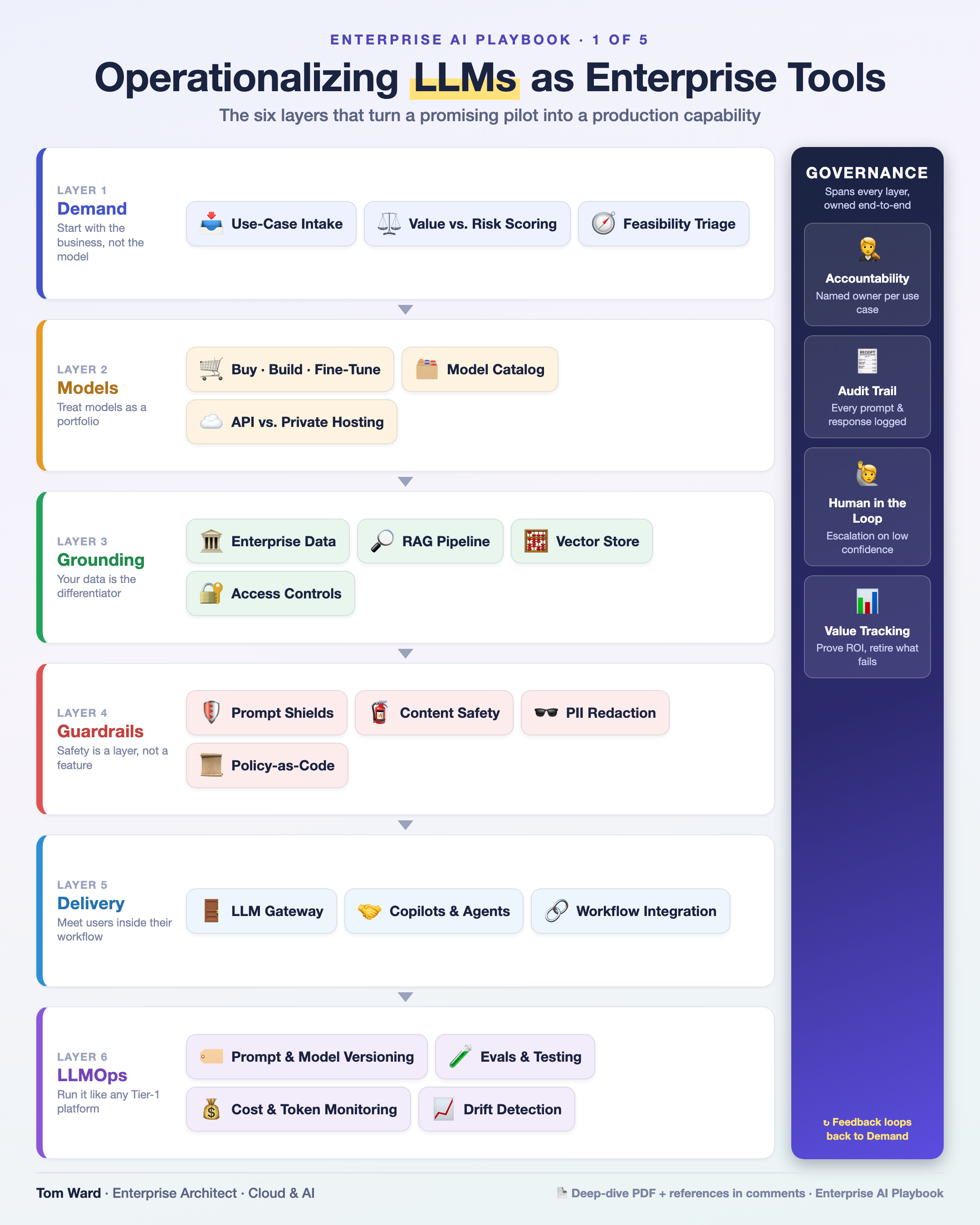
The six layers at a glance
Demand
“Start with the business, not the model”A lightweight intake funnel that scores every candidate use case on business value vs. delivery risk — and has actually said no to something. Most LLM programs fail at intake, before a single token is generated.
Models
“Treat models as a portfolio”The durable asset is not the model — it is the catalog and the abstraction that lets you swap models without re-platforming. Buy vs. build vs. fine-tune is a per-use-case decision, not an enterprise standard.
Grounding
“Your data is the differentiator”Every competitor can call the same model APIs; they cannot call your data. RAG done right means retrieval that enforces the same entitlements as the source systems — at query time, not just at indexing time.
Guardrails
“Safety is a layer, not a feature”Input and output filtering as a shared architectural tier between every model and every user: prompt shields, content safety, PII redaction, policy-as-code. Per-app safety features guarantee inconsistency.
Delivery
“Meet users inside their workflow”Adoption is a delivery-architecture problem. Embed assistants where the work already happens, and route everything through an LLM gateway — your cost-control, audit, and vendor-independence insurance.
LLMOps
“Run it like any Tier-1 platform”Prompts are code: versioned, reviewed, deployed through a pipeline. A golden eval suite gates every change, and runtime telemetry watches cost, latency, refusals, and drift like you watch uptime.
The 10-point readiness checklist
Score one point per true statement. Below seven, fix the gaps before scaling further.
- Every production use case has a named business owner and a written error-tolerance statement.
- An intake process scores value vs. risk — and has actually said no to something.
- Applications reach models only through a gateway; direct API wiring is prohibited.
- Retrieval enforces source-system entitlements at query time.
- Input and output guardrails are a shared service, mapped to OWASP's LLM Top 10.
- Prompts and model versions are under version control and deployed via pipeline.
- A golden eval suite gates every prompt, model, or retrieval change.
- Token cost is attributed per use case, with budgets and anomaly alerts.
- Every prompt/response is logged and reconstructable for incident review and audit.
- Value is measured quarterly against the original business case — and at least one use case has been retired.
Going deeper
Sources worth your time, roughly in the order a program team should read them.
- NIST AI Risk Management FrameworkThe de-facto governance vocabulary for US enterprises — map your controls to it and regulator conversations get dramatically easier.
- OWASP Top 10 for LLM ApplicationsThe fastest way to brief a security team on LLM-specific threats: prompt injection, insecure output handling, data poisoning, excessive agency.
- Microsoft Azure Well-Architected Framework — AI WorkloadsConcrete design guidance for production AI workloads; the patterns translate beyond Azure.
- AWS Well-Architected Framework — Generative AI LensAWS's counterpart to the Azure guidance: lifecycle, cost, and operations best practices for GenAI workloads.
- Google Secure AI Framework (SAIF)A security practitioner's view of the AI stack — a useful complement to OWASP for the guardrail layer.
- MITRE ATLASAdversarial threat landscape for AI systems, in the familiar ATT&CK style.
- Anthropic — Building Effective AgentsClear-eyed engineering guidance on when simple LLM workflows beat autonomous agents.
- McKinsey — The State of AIThe adoption survey your executives have already read — useful for meeting the business case where it starts.
- Stanford HAI — AI Index ReportThe annual evidence base: adoption, cost curves, and capability trends.
Next parts ship over the coming weeks.
Get the next part by email