Establishing Ethical, Accountable AI Governance
How to turn AI principles into platform-enforced controls across five pillars — accountability chain, principles made testable, model risk management, controls as code, and evidence & audit — anchored to the NIST AI RMF and mapped to the EU AI Act and ISO/IEC 42001 so regulators recognize the vocabulary.
By Tom Ward, Enterprise Architect — Cloud & AI
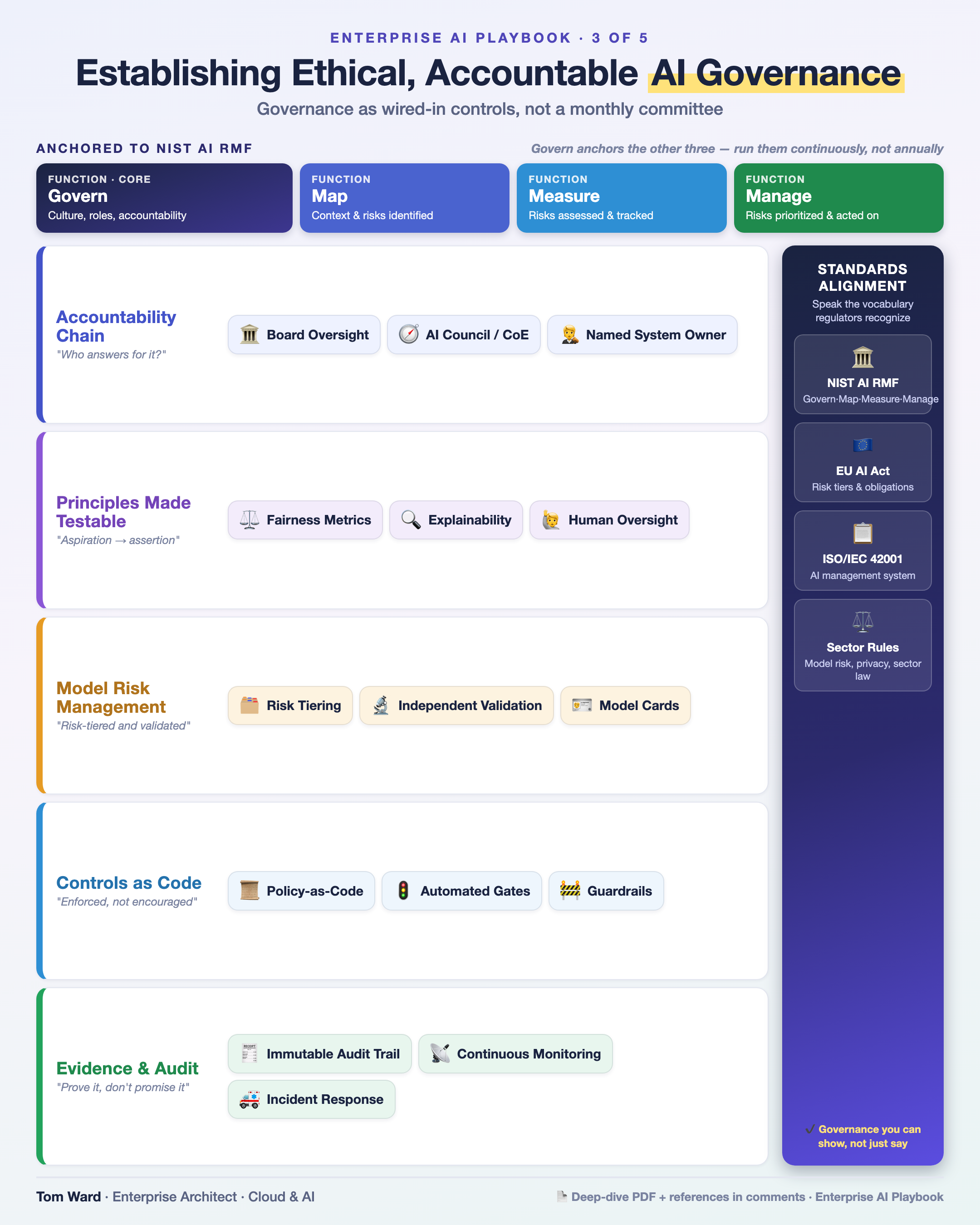
The five governance pillars
Accountability Chain
“Who answers for it?”A clear line from the board that sets risk appetite, through the council or CoE that translates it into policy, down to a single named human who owns each production system. Diffuse accountability is how organizations discover the hard way that “the model decided” is not an answer a regulator, customer, or court accepts.
Principles Made Testable
“Aspiration → assertion”Anyone can publish principles; few can prove they hold. Translate each aspiration into a testable assertion — fairness into a measured disparity threshold, transparency into an explainability requirement, human oversight into a named checkpoint with an SLA — with depth tied to the system's risk tier. A principle you can't test is a press release, not a control.
Model Risk Management
“Risk-tiered and validated”Banking has managed model risk for a decade under the SR 11-7 tradition, and it transfers directly: tier by potential harm, subject high-tier models to independent validation by someone who didn't build them, and document each in a model card. GenAI's twist is that validation becomes continuous — foundation models change under you.
Controls as Code
“Enforced, not encouraged”A policy in a PDF is a suggestion; a policy in the deployment pipeline is a control. Move as many governance requirements as possible from “reviewed by a committee” to “enforced by the platform” — automated gates, runtime entitlement checks, guardrails the model can't talk its way past. It's also what lets teams move fast within the guardrails instead of routing around a slow board.
Evidence & Audit
“Prove it, don't promise it”Governance you can't evidence is governance you don't have. Every consequential decision leaves an immutable, reconstructable trail; continuous monitoring turns that trail into an early-warning system for drift and disparity; and a rehearsed incident-response plan turns an AI failure from an existential event into a managed one.
Eight signs your AI governance is real
The same org chart can produce committee theater or wired-in governance. These eight signs separate the governance that survives an audit from the governance that only reassures a boardroom.
- Every production AI system has one named accountable owner — a person, not a team.
- Each ethical principle you publish maps to a measurable test tied to the system's risk tier.
- High-tier models get independent validation by someone who didn't build them.
- At least one governance policy is enforced as code in the deployment pipeline, not just documented.
- An unvalidated model cannot reach production without a logged, deliberate exception.
- Every consequential AI decision leaves an immutable, reconstructable audit trail.
- Your control catalog is mapped to NIST AI RMF (and the EU AI Act, if you touch Europe).
- Your AI incident-response plan has been rehearsed against a real scenario.
Going deeper
Sources worth your time, roughly in the order a program team should read them.
- NIST AI Risk Management FrameworkThe US backbone — Govern, Map, Measure, Manage. Map your controls here and regulator conversations get easier.
- EU AI Act — Regulatory FrameworkThe European Commission's official overview of risk tiers and obligations — mandatory reading if you touch the EU.
- EU AI Act ExplorerA navigable, plain-language companion to the Act's articles and annexes — faster than the legal text.
- ISO/IEC 42001 — AI Management SystemThe certifiable management-system standard for AI — the ISO 27001 equivalent for AI governance.
- OECD AI PrinciplesThe international principles most national regulations trace back to — useful for multi-jurisdiction alignment.
- Microsoft — Responsible AIA mature enterprise implementation of principles-to-practice — a concrete model to borrow from.
- Google — AI PrinciplesAnother vendor's operationalized principles and governance structure — useful for triangulating your own.
Next parts ship over the coming weeks.
Get the next part by email