Aligning AI Initiatives with Business Readiness
A readiness model for matching AI ambition to organizational capacity across five dimensions — strategic fit, data foundation, platform & skills, process fit, and risk & governance — multiplied by the change capacity nobody budgets for. Readiness Gap = Ambition − Capacity.
By Tom Ward, Enterprise Architect — Cloud & AI
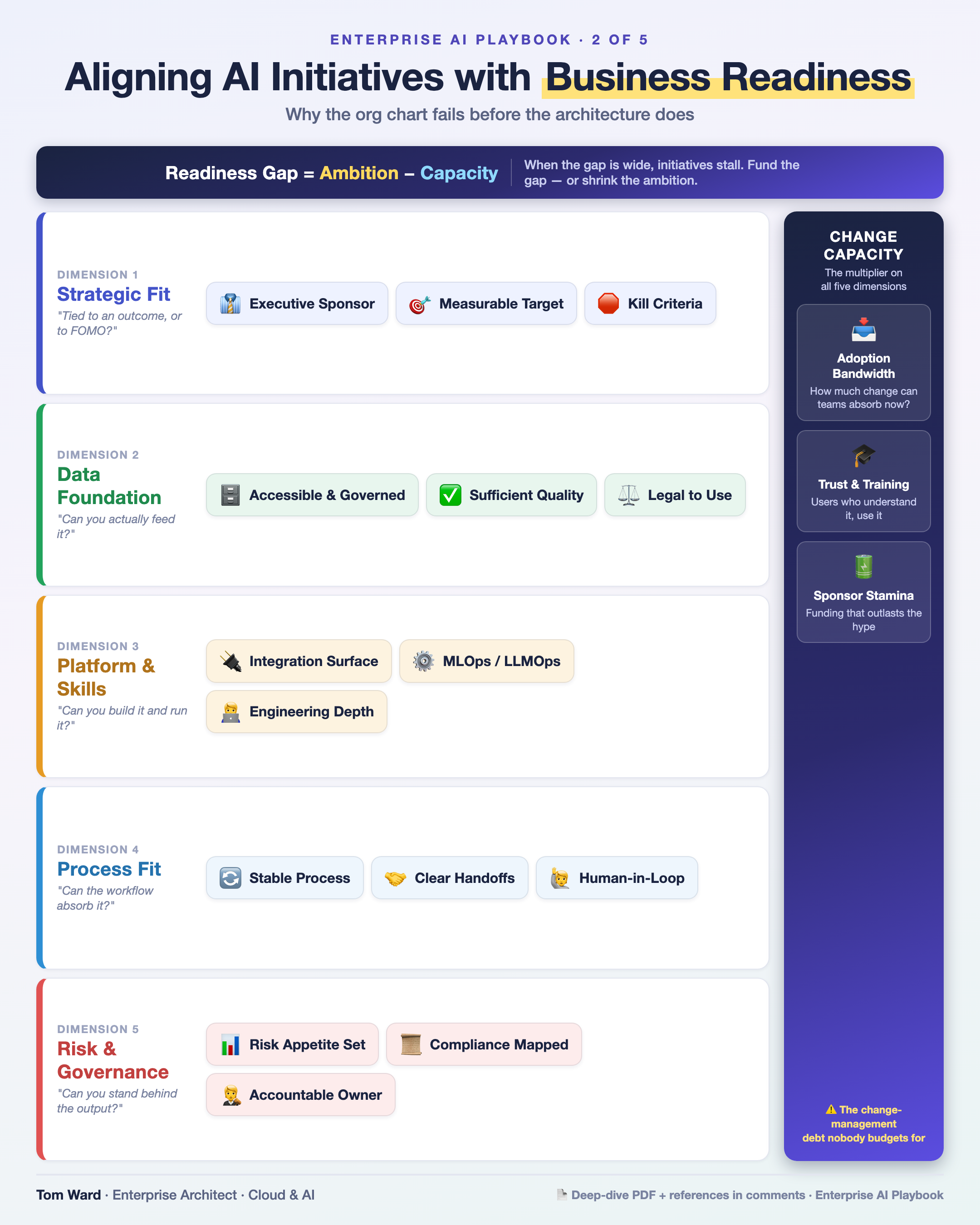
The five readiness dimensions
Strategic Fit
“Tied to an outcome, or to FOMO?”Every initiative must trace to a business outcome someone in the business — not IT — will be measured on. An initiative without an executive sponsor who will defend its budget in the next downturn isn't ready; it's a science project with good PR.
Data Foundation
“Can you actually feed it?”The dimension that quietly kills the most programs. Your demo ran on a clean sample; production runs on the real thing — accessible, governed, sufficient quality, and legal to use. All four. Scope it per use case, not as a paralyzing enterprise-data problem.
Platform & Skills
“Can you build it and run it?”Building a prototype and running a production capability are different sports. You need the platform to deploy, monitor, evaluate, and roll back — and the people to operate a non-deterministic system over time. Ask who runs this on day 90, and whether they're hired yet.
Process Fit
“Can the workflow absorb it?”AI amplifies a process; it doesn't fix a broken one. Drop a model into an unmapped, unstable workflow and you get automated chaos, faster. Readiness includes a deliberate human-in-the-loop design matched to the error tolerance you set in Strategic Fit.
Risk & Governance
“Can you stand behind the output?”Set your risk appetite deliberately, map compliance obligations, and name who is accountable — before you build, not at the launch review. Treated as a design input the way NIST's AI RMF frames it, governance becomes requirements you can build against rather than a blocker.
Six gating questions
Answer each honestly for a specific initiative — not your organization in the abstract. Every “no” is the dimension to close before you commit the budget.
- This initiative traces to a measurable business outcome with a named executive sponsor who will defend the budget.
- The data it needs is accessible, governed, sufficient quality, and legal to use — verified, not assumed.
- You can not just build it but operate it — deploy, monitor, evaluate, roll back — with people who already exist.
- The target workflow is stable and mapped, with a deliberate human-in-the-loop design.
- The risk tier is set, compliance is mapped, and one person is accountable for the system's output.
- Your organization has the change capacity — bandwidth, trust, training, sponsor stamina — to absorb it.
Going deeper
Sources worth your time, roughly in the order a program team should read them.
- McKinsey — The State of AIAdoption benchmarks to calibrate your ambition against what peers actually achieve.
- MIT Sloan Management Review — AI & Business StrategyResearch on tying AI initiatives to strategy — the core of the Strategic Fit dimension.
- Deloitte — State of AI in the EnterpriseEnterprise readiness survey: what separates high-outcome adopters from the rest.
- NIST AI Risk Management FrameworkThe governance vocabulary for the Risk & Governance dimension — Govern, Map, Measure, Manage.
- Prosci ADKAR — Change ManagementA practical model for the change-capacity multiplier most AI plans ignore.
- WEF — Empowering AI LeadershipA board-level toolkit for the executive-sponsorship and oversight questions.
- OECD.AI Policy ObservatoryCross-jurisdiction policy and regulation context for mapping compliance early.
Next parts ship over the coming weeks.
Get the next part by email