Leading Agentic AI-Driven Workflow Change
What changes when AI stops suggesting and starts acting. A five-rung autonomy ladder (Assist → Draft → Propose → Supervise → Autonomous) and the five design decisions — delegation, permissions, human checkpoints, reversibility, trust — that must sharpen at each rung, over a human control plane that scales with autonomy.
By Tom Ward, Enterprise Architect — Cloud & AI
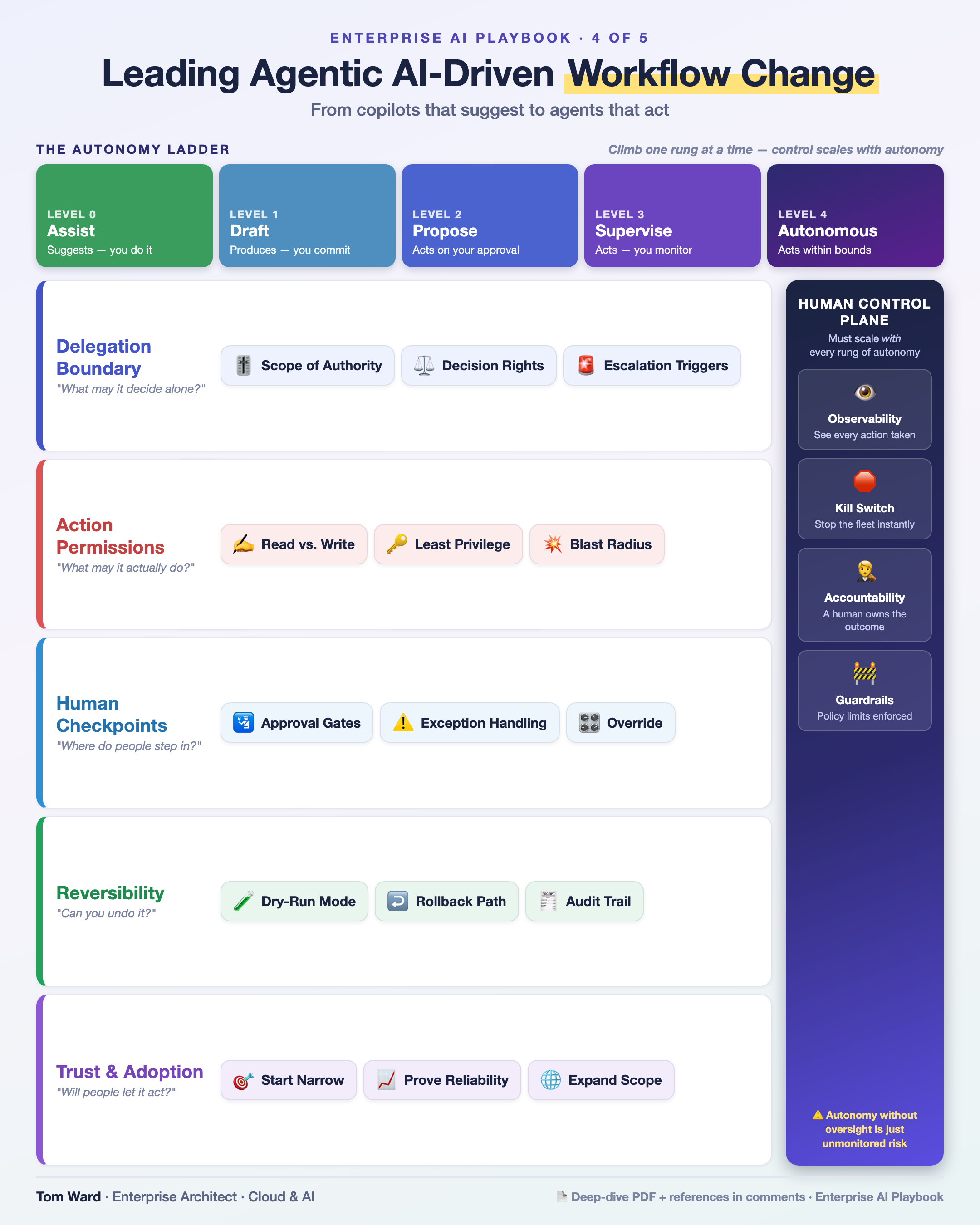
The five design decisions
Delegation Boundary
“What may it decide alone?”The moment AI moves from suggesting to acting, the first question is organizational, not technical: what has this agent been delegated, and where does its authority end? Define scope, decision rights, and escalation triggers in writing. An agent without an escalation path isn't autonomous — it's unsupervised.
Action Permissions
“What may it actually do?”Delegation is what it may decide; permissions are what it can physically do to your systems. An agent inherits the blast radius of every credential you hand it — and acts thousands of times a minute. It should never hold permissions its accountable human owner doesn't. Constrain the tools, not just the prompts.
Human Checkpoints
“Where do people step in?”Every rung is a statement about where the human sits relative to the action: approve each one, monitor and intervene on exception, or audit after the fact. Place checkpoints where they add safety without recreating the manual process — anchored to each action's error tolerance, not a blanket policy.
Reversibility
“Can you undo it?”The safest way to raise autonomy is to lower the cost of a mistake. Dry-run modes, rollback paths, and complete audit trails let reversible actions climb higher on the ladder; one-way doors demand a human hand on every one. Investing in undo is investing in the speed at which you can safely delegate.
Trust & Adoption
“Will people let it act?”The leadership half of the work. An agent trusted by its designers but not by the people whose work it touches will be bypassed — rightly, until it earns the trust. Start narrow, prove reliability on a low-stakes slice, expand on evidence. Bring the frontline in as co-designers, not obstacles.
Five gates before you promote an agent a rung
The durable agent programs climb the ladder deliberately — each rung earning the next. Clear all five gates before raising an agent's autonomy level.
- The delegation boundary for the new level is written down and signed off by an accountable owner.
- Action permissions are scoped to the task and never exceed the human owner's own access.
- The human checkpoint for this level is designed, staffed, and won't drown in approval fatigue.
- The new actions are reversible — or a one-way door with a deliberate, documented exception.
- The control plane — observability, kill switch, guardrails — already covers the new scope.
Going deeper
Sources worth your time, roughly in the order a program team should read them.
- Anthropic — Building Effective AgentsThe canonical engineering guide on when simple workflows beat autonomous agents, and how to build the latter well.
- OpenAI — A Practical Guide to Building AgentsDesign patterns for agent tools, guardrails, and human-in-the-loop — a useful counterpart to Anthropic's.
- Microsoft — Azure AI Agents OverviewA vendor implementation view: how tool-calling, orchestration, and controls come together in practice.
- MITRE ATLASThe adversarial threat landscape for AI systems — essential for reasoning about an agent's blast radius.
- NIST AI Risk Management FrameworkThe governance vocabulary for delegation, accountability, and control — Govern, Map, Measure, Manage.
- Kotter — 8-Step Change ModelA leadership framework for the trust-and-adoption half of agentic workflow change.
- OECD.AI Policy ObservatoryCross-jurisdiction context for the accountability and oversight expectations regulators are converging on.
Next parts ship over the coming weeks.
Get the next part by email