You Don't Choose Five Nines. You Buy Them.
Three nines is 43 minutes of downtime a month; five nines is 5 minutes a year. You don't close that gap by trying harder — you choose a deployment archetype that can deliver it, and pay what it costs. A working guide to the six cloud archetypes as a ladder, from Zonal to Global (with Hybrid and Multi-cloud as compositions, not rungs), drawn from Berenberg and Calder's Open-Access ACM Computing Surveys paper.
By Tom Ward, Enterprise Architect — Cloud & Infrastructure
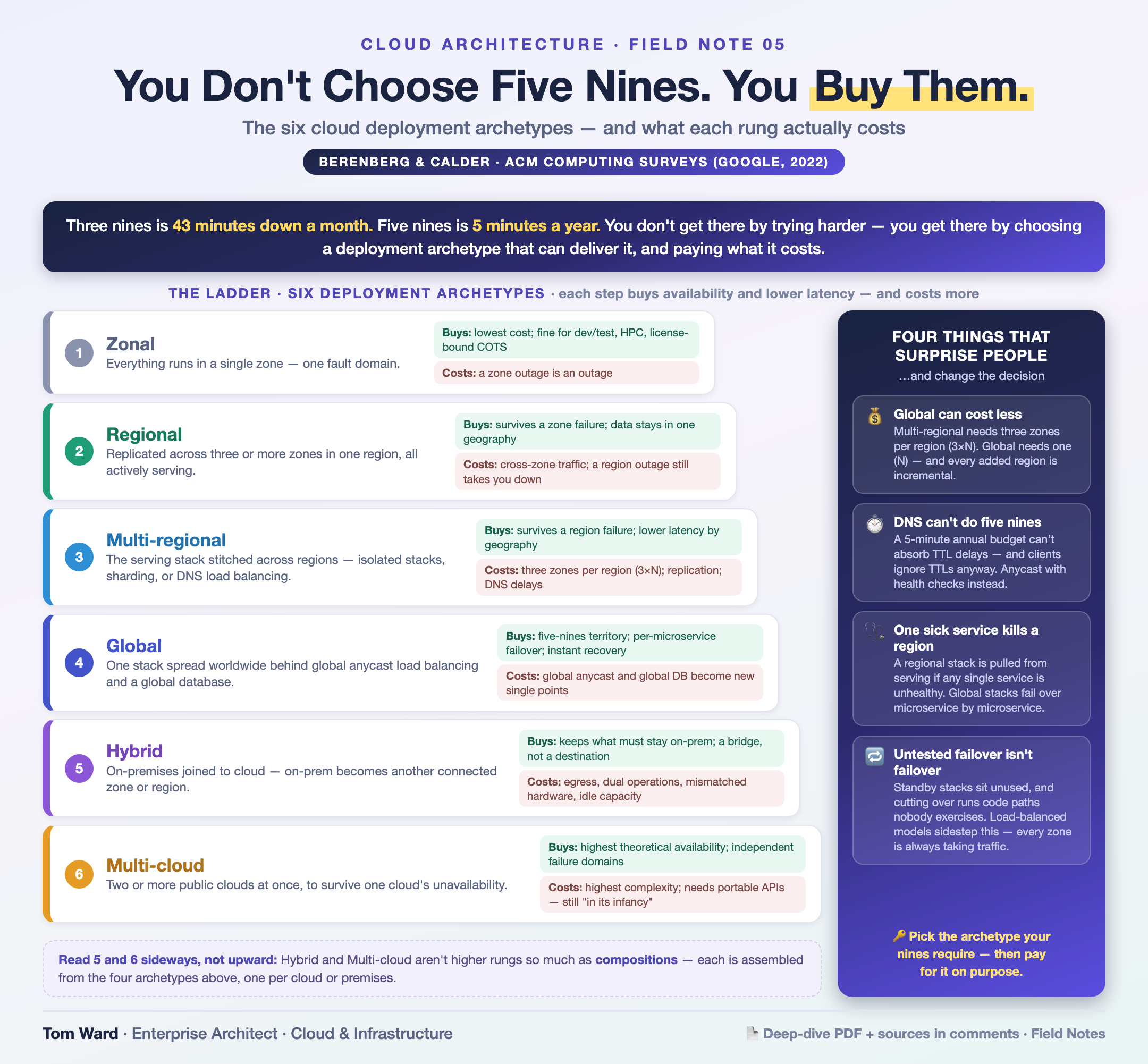
The ladder: six deployment archetypes
Availability is a purchase, not an aspiration. Each rung buys more availability and lower latency — and costs more. Not every application needs the top of the ladder: the paper separates business-critical applications from line-of-business and internal ones, and only the first group is usually worth the climb.
Zonal
“One fault domain”Every component runs inside a single zone. If the zone goes down, the workload restarts elsewhere from its last checkpoint or fails over to a standby — so a zone is a single failure domain, and this is not a high-availability posture. It stays the right answer for a real set of cases: HPC and TPU pods needing supercomputer-like bandwidth in one zone, developer test workloads, and license-bound COTS whose per-instance costs make redundant copies prohibitive. Buys: lowest cost and no cross-zone egress. Costs: a zone outage is an application outage.
Regional
“Survives a zone failure”The application is replicated across three or more zones inside one region, all actively serving — the active-everywhere posture is what separates it from zonal. Best practice is to replicate across every zone and size each roughly equally, so capacity genuinely exists when a zone is lost; data is typically replicated synchronously within the region. Buys: survives a zone failure with no user impact, and keeps data in one jurisdiction. Costs: cross-zone traffic and replication, and a region-wide outage still takes you down.
Multi-regional
“Survives a region failure”The serving stack is stitched across several regions — via isolated regional stacks with data sharding (the paper's example is banking: us.hsbc.com for US customers, hsbc.co.uk for UK ones), DNS load balancing across isolated stacks, or DNS with a custom multi-region load balancer. Buys: survives a whole region failure and cuts latency by geography, with data residency per jurisdiction. Costs: three zones in every region for redundancy (3×N), replication, and DNS TTL delays that cap achievable availability.
Global
“Five-nines territory”One stack spread worldwide behind global anycast load balancing — a single virtual IP mapped everywhere — with a globally available database. The stronger Global Services Stack model load-balances each microservice globally so it can fail over independently, and it's the cheapest multi-region option because it needs only one zone per region and expands incrementally. Buys: instantaneous recovery (the requirement for five nines) and per-microservice failover. Costs: the anycast VIP and global database become global failure domains with no regional isolation to fall back on.
Hybrid & Multi-cloud
“Compositions, not rungs”Read these sideways rather than upward. Hybrid connects on-premises to public cloud, so on-prem becomes another connected zone or region — a bridge and a home for what can't move. Multi-cloud runs across two or more public clouds so one provider's failure is survivable, the highest theoretical availability because the failure domains are genuinely independent; the paper calls it “in its infancy.” Neither is a higher rung: each is assembled from the four archetypes above, one per cloud or premises. The honest question isn't “should we be multi-cloud?” but “which archetype are we running, in each place we run?”
Four things that surprise people
Most of the ladder is intuitive: more redundancy, more availability, more cost. These four findings are not — and each one changes a decision.
- Surprise 1
Global can cost less than multi-regional
3×N versus NA multi-regional deployment needs three zones in every region for zonal redundancy, so it runs at 3×N. A global deployment needs only one zone per region (N), and each added region is incremental rather than multiplied. The cheaper option is also the more reliable one — which inverts how availability is usually budgeted, where “global” is assumed to be the expensive end of the menu.
- Surprise 2
DNS failover cannot deliver five nines
the protocol won't allow itFive nines leaves roughly five minutes of unavailability a year, which rules out any manual mitigation — recovery has to be instantaneous. DNS can't provide that: TTL delays are built into the protocol, and clients like browsers routinely disobey TTLs anyway. If your failover story is “we'll repoint DNS,” you've already chosen a lower tier. Five nines needs anycast load balancing with integrated health checking.
- Surprise 3
One sick microservice takes down a whole region
the real case for globalWith a regional application stack, if any single service in the region is unhealthy the entire region is pronounced unhealthy and pulled from serving — even though the rest of the stack is fine. A global services stack doesn't work that way: each microservice is independently load-balanced, so only the affected service moves. This, more than geography, is the real architectural argument for the global model.
- Surprise 4
Failover you never test isn't failover
an untested standby is an assumptionStandby stacks sit unused, and there's always a risk the standby isn't ready when it's needed. Worse, the act of failing over exercises code paths that are rarely stressed — and those paths can themselves cause the outage. Load-balancing-based models sidestep the whole problem, because every zone and region is always taking traffic. If you keep a standby, you must routinely promote it in production.
The Archetype Selection Test
Ten checks before you commit an application to a deployment archetype. Score one point per honest “yes.” Below seven, you have a preference rather than a decision — and you'll discover the gap during an incident.
- The availability target is stated in minutes, not nines, and the business has agreed to that number.
- You know which application type this is — business-critical, line-of-business, or internal — and only the first is climbing the ladder.
- RPO and RTO are defined per application, and the archetype was chosen to meet them rather than justified after the fact.
- Data residency and regulatory constraints were mapped before the archetype was picked, not discovered after.
- You can name which fault domain each rung protects against — zone, region, cloud — and which ones you remain exposed to.
- If you need five nines, recovery is instantaneous via load balancing — no manual step fits inside a five-minute annual budget.
- If you rely on DNS for failover, you have consciously accepted that five nines is out of reach.
- Failover paths are exercised on a schedule — a standby you never promote is a standby you cannot trust.
- Your global dependencies — anycast VIP, global database, global control plane — are themselves counted as failure domains.
- The cost is understood all-in: instances per zone, zones per region, cross-zone and cross-region egress, replication, redundant storage, and the skills to operate it.
Going deeper
Sources worth your time, roughly in the order a team should read them.
- Deployment Archetypes for Cloud ApplicationsBerenberg & Calder, ACM Computing Surveys 55(3), Article 61 — the survey this note is drawn from. Open Access, free to read in full.
- Google Cloud — Deployment ArchetypesThe Architecture Center's applied, illustrated version of the same six archetypes — the practitioner companion to the paper, kept current.
- Google SRE — the booksError budgets, availability targets, and the operational discipline behind the nines. Free to read online.
- Google Cloud — Disaster Recovery Planning GuideTurning RPO and RTO into concrete deployment and data-replication choices.
- Google Cloud — Load BalancingGlobal anycast load balancing and integrated health checking — the mechanism behind instantaneous recovery.
- AWS — Multi-Region Application ArchitectureThe same archetypes expressed in AWS terms, with a reference implementation.
- Azure Front DoorMicrosoft's global entry point and failover tier — the Azure counterpart to global anycast load balancing.
More field notes ship as they're written.
Get the next note by email